Tuesday, March 20, 2012

Seed Starting 2012

On this, the first official day of Spring (although you wouldn't know it with 4' feet of snow currently on the ground,) I've decided to share my list of what plants I have started under my grow lights, and what I will be starting soon. I'm a few weeks behind this year, but I figured that it will work out well since I'm guessing it will be months before we can see actual dirt again.

Currently growing:

1. Tomato 'Red Robin' - I'm growing this guy solely as a houseplant, with no intention of putting him outside. It's a very dwarf variety of tomato, only getting 8-12" high, and can grow just fine in a 6" pot. It's a perfect fit on my grow light shelf, and the tomatoes, although small, are the best tasting little suckers ever. So sweet they're practically candy.

'Red Robin' seeds available at totallytomato.com. I have no pictures of ripe tomatoes because I ate them all. 

2. Assorted herbs - basil, parsley, cilantro, thyme, green onions, and oregano. I start all my herbs much earlier than necessary so that I can use them for a while during the winter before moving them outside. The basil, however, remains inside. I can't get it to do well in our cold Alaskan summers!

3. Leeks - these guys take a long time to mature, so I generally start them in January or February.

4. Celery - ditto.

5. Cobaea scandens, or Cup and Saucer Vine. I start these guys at my house for work, and move them to the greenhouse later. I should have started them in January, and didn't get them in until early March, but I think they'll still be big enough come actual spring that they'll bloom for us this summer.

Photo courtesy of Park Seed, which is also where I happened to order them.
6. Sweet pea 'Zinfandel' - a fragrant, deep burgundy sweet pea. This is my first year trying them, so we'll see how it goes.


7. Snapdragon 'Chantilly Deep Orange' - an open-faced variety, still my favorite. Snaps also take a long time to mature, so I generally start them in February, and pinch them back a couple times before they finally make it to the garden.

Snapdragon 'Chantilly Deep Orange'
Seeds I will be starting in the next two weeks:

1. Tomato 'Glacier' - forget 'Stupice.' This is my new favorite. Very tasty, and produces well in cool weather.

2. Petunias - I still haven't decided on a variety, but it will probably be the magenta wave type, as these tend to do really well for me.

3. Dahlia 'Aurora' - if I ever get around to calling the guy who sells the tubers locally, that is. I probably should have started these March 1st. Oh well!

Doesn't this just make you go "Oooooooo....."? Photo courtesy of The Persistent Farmer, which is where I plan on buying the tubers if I ever get around to it.

Anyone else have any seeds started? Trying anything new this year? Know the perfect time to start that perfect plant? Feel free to share!

Saturday, March 10, 2012

Green Walls and Vertical Gardening...not just for the outdoors.

Just had to do a quick post to show off our latest project at work:

Bromeliads, prayers plants, pothos 'Neon,' and holly ferns. Photo courtesy of Green Connection.

Yup, it's a green wall full of house plants. Cool, eh? This system, made by ASI, works fairly well and is the most affordable and attractive set up we've found so far. And because the plants are still in their individual pots, it's a very flexible set up, easy to switch things around if you want a different look or if a particular plant isn't doing well. 

Maintenance is simple: each plant has a wick running from the bottom of the grow pot, which rests in the tray. Fill the trough with water and the soil slowly wicks it up as needed. Every once in a while we have to readjust one of the wicks, but so far things are doing nicely.

Here's another one I designed:

Peace lilies, liriope, philodendron 'Limelight,' and holly ferns. Photo courtesy of Green Connection.
Can you tell my tastes run in the "crazy wild plant explosion" direction? The client actually ended up not liking this one, and we replaced everything with all one type of plant. But who cares what they think, right? Silly boring corporate-minded office people. Give me exploding plants any day.

Anyhoo, while green walls were previously limited to corporate settings and those with large incomes, there are now models, like the one above, that are relatively affordable and making their way into residences. If you have good light in your home and really want to make a statement, living art could be the thing for you. 

Friday, February 24, 2012

Container Garden Design

So my two readers out there may be thinking that it's really rather early to be planning garden designs, but what is the non-gardening season for but to dream about the gardening season? Plus, if you grow a lot of your plants from seed like I do, this is the right time of year to be browsing seed racks and catalogs, and to be setting up your grow lights and getting a few things started.

Last summer I was invited to help with the planter design process at work. While attempting to put together fabulous container gardens for our clients I gleaned several handy tips from our design manager, many of which I'll pass along in this post:

1. Mix it up.

A basket full of one kind of flower is pretty. A basket full of tastefully selected flowers of different shapes and colors combined with interesting foliage and textures can be breathtaking.

Pansies, begonias, astilbe, petunias, and Japanese hakone grass. Photo courtesy of Green Connection.
Don't be afraid to mix upright plants with cascading ones, or spiky plants with soft, billowing varieties. It's okay to add some plants that don't flower; grasses and other foliage plants can make an average arrangement into something spectacular. Add color variety in flowers or foliage for even more interest.

2. Mix it up...but not too much.

While variety is the spice of life, it's important to keep things unified so they don't appear chaotic and disorganized. This can be done by repeating some elements, like texture or color, throughout the design. In the picture below several colors are unified by the repeated use of daisy-like blooms.

A symphony of daisies. Photo courtesy of Green Connection.
Note the repeated use of chartreuse foliage in the photo below. (I loooove limey foliage! Drool.)

Dracaena spike, two pelargonium varieties, verbena, and lysimachia. Photo courtesy of Green Connection.
3. Keep things in scale.

Because nothing looks stoopider than a little tiny plant in a ginormous container, or vice verse. Most flowers come in several different flavors, so be sure to read plant tags and seed packages closely for size information.

Begonias, calibrachoa, and lysimachia. Photo courtesy of Green Connection.
The small planter in the picture above would have looked decidedly odd if filled with overly large plants, such as 3' tall snapdragons or a dinner plate dahlia. Luckily for the mailbox planter, it was filled with appropriate (and adorable) small-scale plants.

4. Choose the right plants for the right place

No matter how lovely your design is, the finished product won't look good if you use plants that don't grow well in your specific area. Is the site shady? Windy? Cool and moist? Hot and dry? For lush and vibrant plants, match the type of plants to the surrounding environment. Here in Alaska it's best to stick with cool-season plants. Lucky for us, there are a lot of annuals that do well up here.

Dogwood, scented geranium, dahlia, snapdragons, osteospermum, and petunias. Photo courtesy of Green Connection.

Osteospermum, bacopa, and helichrysum. Photo courtesy of Green Connection.
5. Have fun!

The most important thing to remember when designing a container garden is to have fun! Don't feel like you have to stick to what's currently featured on HGTV. So what if some people don't care for pink and orange together? If you like it, do it. (I personally love hot pink and tangerine together.) The best part about garden design is coming up with something that is uniquely yours and then being able to share it with others.


Sambucus, ageranthemum, pelargonium, calibrachoa, and lysimachia. Photo courtesy of Green Connection.

Well, guests and loyal readers, do you have any tips to share on container garden design? Plant combinations you find particularly pleasing? Creative uses for a specific type of container or flower? Let us know! Share your knowledge! We'd love to hear your ideas!

Saturday, September 17, 2011

Stargazing and Crocus Carpets

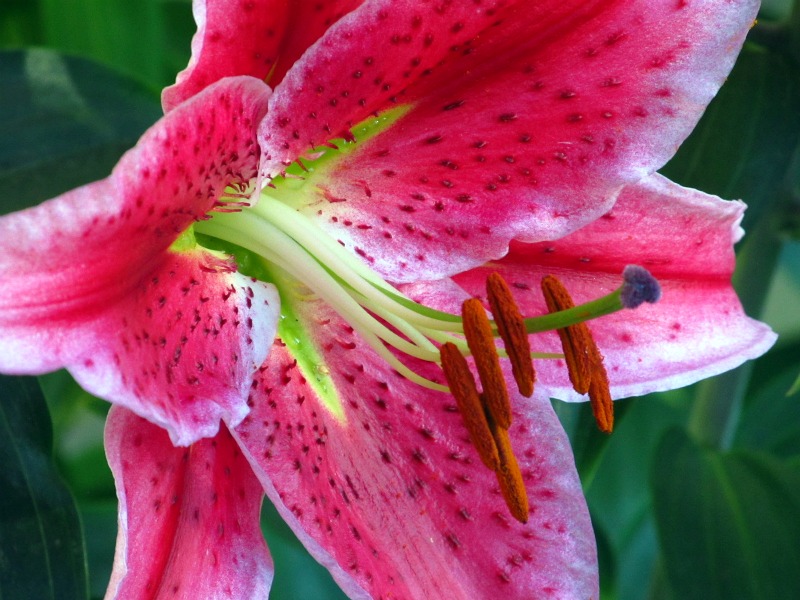
I always have mixed feelings when my Stargazer lilies bloom. On one hand, they're Stargazers:


Enough said, right? And they smell as good as they look. And I have a whole posse of them:


My neighbors can smell them over the fence, which should give you some idea of how potent these suckers are. Some people find the smell unpleasantly overpowering. I am not one of those people.

So anyhoo, I'm always happy to see the Stargazers exploding onto the scene in my garden, but I'm always a little sad too, because they are one of the very last things to bloom and they double as harbingers of autumn. I love autumn, but it has this nasty habit of leaving the door open for winter, and I'm just not ready for that this year. Sigh.

But with fall comes new exciting garden projects, including one of my favorites, which is shopping for and planting bulbs. This year I came home from Costco with Narcissus 'Ice Follies,' Tulipa 'Oxford' and 'Oxford Elite,' and Crocus 'Remembrance' and 'Pickwick.' I'm particularly excited for the crocus, because I have decided that my sorry excuse for a lawn needs to look like this:

Photo courtesy of the US Botanical Garden in Washington, DC
Just what every Alaskan gardener needs and deserves to see in spring!! I've heard of two methods for planting crocus in turf:

1. Cut a patch of turf, peel it back, and scatter the bulbs (corms, really, since we're talking crocus.) Fit the patch of turf back into the hole, covering the bulbs.

2. Use a drill and a spade bit to drill individual holes into the lawn. Drop a corm in each hole and back fill with good soil or compost. (I heard this one from the head gardener over at the Alyeska Prince Hotel.)


You can see which method I've chosen. My lawn is really compacted, so I thought maybe this way I'd be aerating the soil too. We'll see what happens.

Supposedly you can mow your lawn as usual, and the crocus leaves blend right in after the flowers are done. I'll be posting flower carpet pictures next spring if everything goes according to plan!

Something to keep in mind when planting flowers in your lawn: you can't use chemical herbicides or heavily concentrated fertilizers if you want the bulbs to live. So organic fertilizers are the way to go, and you may have to get creative with weed control.

Have any of you ever done the flower carpet thing? What were your results? Any handy tips you want to share?

Sunday, July 31, 2011

Garden Highlights 2011

To my few loyal readers out there I apologize for the long hiatus! My only excuse is that I've been doing lots of hiking, and of course, lots of gardening. Fortunately, I've taken lots of pictures to make up for it. Here's a sample of what's been going on in Gretchen's Garden this summer:


That's compost, baby. I did a whole lot of screening and spreading of compost this spring. I have poor soil in several locations in my garden, so my plants appreciate a yearly addition of good compost.


I also spent quite a bit of time installing drip irrigation in my raised veggie boxes and annual beds. So far it's working wonderfully and saving me a lot of time, although I did make a few mistakes here and there. Any of you enlightened readers who have installed drip irrigation will notice that in the picture above I have the drip emitter on backwards. Fortunately, it didn't take me long to figure out why they kept popping off!


I spent time pruning several of my shrubs, although I need to do more....


I pulled up lots and lots and lots of these! My yard was completely weed free for about a week. It was a great week. Now I need to do it all again....sigh.

And now for the garden highlights. I know you all really just want to see pictures of pretty flowers, so here they are: 

Thalictrum aquilegifolium
Snapdragon 'Chantilly Deep Orange', quite possibly one of my favorite snaps.


A new lily variety in my garden - only 12" tall. Always start your lilies from bulb - it's easy, and so much less expensive than buying lilies in pots.
The tulips put on quite a show this year. They look great against my lime-leafed mock orange, which is also a new addition to the garden.
I tried Carex 'Red Rooster' in my annual bed this year and love it!
Dianthus deltoides
A wide variety of kales and lettuces this year. My soups and salads have been fabulous!
Strawberry bed, year 2. Filling out nicely, although I added way too much nitrogen last year in the form of corn gluten. As a result, the berries this summer have been few and small. (My lawn needs mowing, as usual.)
My dahlias are finally starting to bloom, a month later than usual. I've been hearing from people all over town that they are having slow dahlias this year too.
Lupine 'Morello Cherry.' Totally worth growing from seed - it blooms the first year.

I'm loving the addition of a few marigolds to my herb garden this year...it's never looked better.
So there's my garden so far in a nutshell. It's a little messier than usual this year, but it always surprises me how vibrant it can look even when not manicured as it should be.

How are your gardens doing this summer? Any new varieties worth sharing?

Sunday, May 8, 2011

Ultra-early Spring Bloomers

Anyone in a far northern area of the world can tell you that when spring comes, most gardeners want flowers and they want them now. I am no exception, and have planted numerous spring bloomers to make myself happy after a long long long winter. For those out there like me who have no patience and want some flowers right away, I've listed some of the plants that bloom earliest in my Anchorage area garden.

Iris reticulata 'Harmony'
Dwarf iris, or Iris reticulata, is usually the first thing to bloom in my garden, although this year the crocus beat them to it. I have them in my rock garden, and in perennial beds planted underneath hostas. The blooms only last a couple of weeks, but they are so cute I don't much mind.

Arabis caucasica
Who wants to see more white after a long dark winter when the only color you see is, well...white?? I avoided planting white flowers for that reason for a while, but then started to realize that I really liked them. They don't remind me of winter after all, and they can really make shady areas of the garden look brighter.

This little guy above often has buds on it even before the snow has completely melted off. I have the white variety, but it also comes in pink and purplish, and there's another white variety with variegated foliage. I grew mine from seed and they bloomed their first spring.

Primula denticulata
I'm quickly becoming a primula addict, and this is one of my favorites. As more buds open up, a ball of flowers forms and pushes up 6-8" above the leaves, which looks very whimsical and Dr. Suess-y to me:

Primula denticulata, late May 2010
And as you can see, they come in a variety of colors.

Primula elatior
Another primrose, Primula elatior, which generally has buds on it before I can get the leaves cleared off in the spring. This is another super easy one to start from seed, and it blooms for a solid month or more. The one pictured above is just starting to bloom. In a couple of weeks there will be ten times as many flowers on this one plant. They're prolific little suckers!

Chionodoxa forbesii 
I'm not sure how to pronounce the Latin name of the cute little flower pictured above, so I usually refer to it by the common name Glory-of-the-snow. It's another bulb, and it's so small I use it to under plant other perennials a lot, especially hostas. It also comes in pink and white, but I think the blue are the most vigorous.

Viola spp.
I know a lot of people don't think much of pansies and violas, being as common as they are, but really...look at that face! It's darling! And they spread so merrily about the garden of their own accord I can't help but let them do their own thing. (A lot of gardeners consider violas to be weedy.) They may tend to grow wherever they please, but they also bloom early, so they're fine by me.

So there's the list of what's blooming in my garden in ultra-early spring. What are you guys growing? What's blooming in your gardens right now?

Sunday, May 1, 2011

Top 5 Reasons to Keep a Garden Log

Or journal, or diary, or whatever you want to call it.

1. So you know what you have.

In spring, when you are cleaning debris from your flower beds and you come across a bizarre and unidentifiable bunch of twigs that you have no recollection of planting, you can look back in your log and figure out what it is.

This happened to me today. I found a really thick, meaty crown of some mystery plant, 12" across, where I can't remember having put anything last summer. I was really sure it wasn't a weed; I admit I can be a lazy weeder, but this was a big freakin' mass of plant, so I'm sure I would have already pulled it if it were something undesirable.

And as I am pretty sure no one else is planting things in my garden while I'm asleep or at work, I checked my 2010 log, and found it is Heuchera 'Brownies.'

2. So you remember the names of what you have.

Because someone is going to ask you what it is, and you will want to be able to tell them. Or you may want to get more of that plant, which is hard to do if you don't happen to remember that it's called Primula denticulata, for example.

3. So you remember to do what you didn't get to last summer.

I can't tell you how many times I've gone through my garden and thought,  "I really should move these lilies over there," or "I need to start the petunias from seed earlier next year," or something similar. Unfortunately, if I don't write it down, it doesn't happen. So I keep wish lists, garden maps, calenders, and to-do lists for the next season, and this really helps me get things ready before the season starts.


4. So significant dates don't pass you by.

Such as when to start all your seeds so they bloom at the appropriate time. Or when to put in your peas and potatoes so they'll sprout but not freeze. That sort of thing.

5. So you can dream.

What's a gardener to do during a long winter in Alaska? Plan for spring, of course! I look in my log to see what performed well, what didn't, and what I should consider trying new.

A garden log can be anything. I used to keep mine in a binder and saved plant labels, bulb packaging, and the like. I've since upgraded to keeping my log on Excel, complete with pictures and links. I still keep a binder, but reserve it for designs old and new, and current diagrams of my perennial, annual, and veggie beds.

It sounds like I'm organized, but I'm really not. I've just found that keeping a few notes really helps me garden smarter and save time every summer.

Do any of you keep a garden log? What works well for you?